
Skip to content
Get a quote

What should a comedian’s website include?

A comedian’s website has three jobs: help promoters and bookers say yes, help fans find your next gig, and keep people coming back. Here’s what that takes, and what it costs.

From Committee, web designers with experience producing live comedy in the US and Europe.

The Mad Cow Comedy homepage: a photo of a laughing audience and a button to view the agenda.

The essentials

Six things every comedian’s website needs. The screenshots are mockups of a fictional comedian’s site, to show what each one can look like.

A short bio

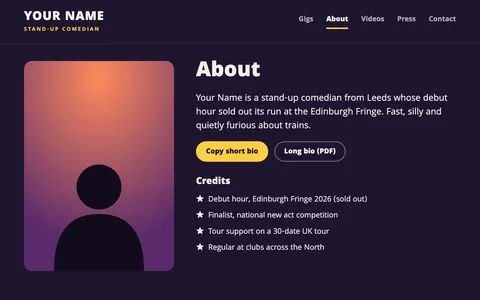
Two or three sentences in the third person that promoters can paste straight into a listing, plus a longer version for press. Mention the credits people recognise: festivals, competitions, TV and radio.

A mockup of a comedian’s About page: a silhouette portrait, a short bio, buttons to copy the bio or download a longer one, and a list of credits.

Upcoming gigs with ticket links

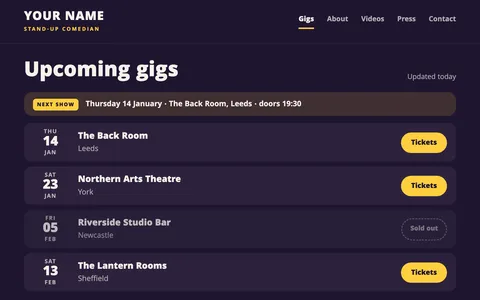
The thing most visitors come for. Date, venue, town and a ticket link for every show, with the next one at the top. It has to be quick to update from your phone, or it goes out of date.

A mockup of a comedian’s gig list: the next show highlighted, then dates, venues and towns, each with a Tickets button or a Sold out label.

Clips

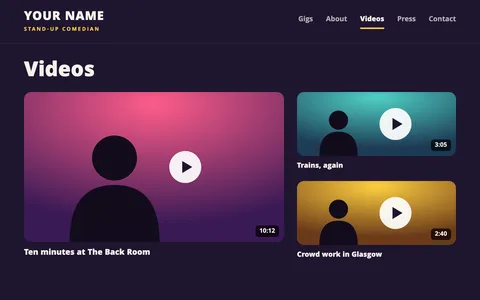
One or two short clips of your best material, embedded from YouTube, Vimeo or Instagram. Bookers want to see you work a room.

A mockup of a comedian’s Videos page: one large clip and two smaller ones, each with a play button, a running time and a title.

Press photos and a press kit

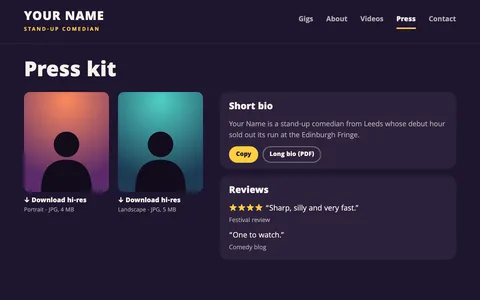
High-resolution photos people can download without asking, your bio and your best review quotes. It saves you emails and gets your name spelt right.

A mockup of a comedian’s press kit: two photos with download links, a short bio with a Copy button, and review quotes with star ratings.

A mailing list

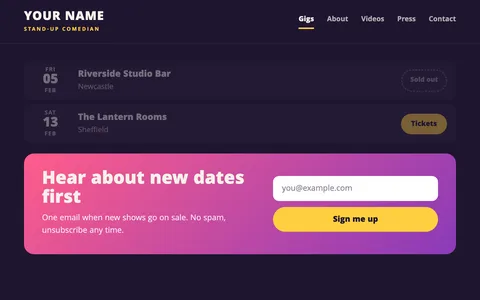
Social media reach comes and goes; a mailing list is yours. A simple sign-up on every page is enough.

A mockup of a mailing list sign-up under a gig list: “Hear about new dates first”, an email field and a Sign me up button.

Contact details for bookings

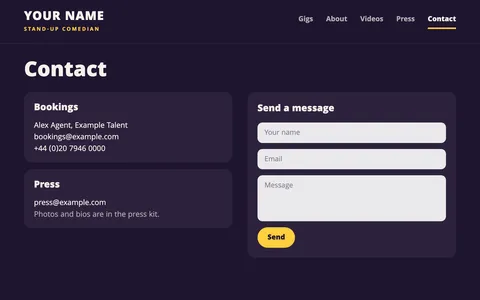
Your agent’s details, or a form that reaches you. Make it easy to find.

A mockup of a comedian’s Contact page: the agent’s booking details, a press email address and a message form.

If you’re running a show

A show needs a bit more than a personal site.

  • A page for each show

    Dates, venue and a ticket link for every show, so your listing, posters and social posts all point to the same place.

  • Lineup pages

    For a recurring night: who’s on this month, with photos and links, updated in a couple of minutes.

  • Reviews and star ratings

    Add quotes and stars from your phone during a run, while they can still sell tickets.

  • A QR code for print

    A code for your flyers and posters that opens a ticket page you can update after they’re printed.

  • A press page

    Show copy, production photos and contact details, ready for reviewers, venues and festival programmers.

  • Mailing list sign-up

    Bring this year’s audience back for your next show, your tour or next year’s festival.

Taking a show to Edinburgh? See our Fringe 2027 package. Running a club or theatre? See websites for comedy venues.

What a comedian’s website costs

A custom site from a designer can cost anything from a few hundred to a few thousand pounds or euros, depending on how much it does. For most comedians, our Solo package covers everything on this page, at a fixed price agreed before we start.

Hosting and a domain are extra, both in your name, so the site is yours.

Running a show, a festival run or a venue? See all our packages.

Timelines start once we have your copy, photos and links. Prices are in euros and include VAT where it applies; pound amounts are approximate.

Common mistakes, and how to avoid them

The problems we see most often on comedians’ websites, what each one costs you, and what we do about it.

  • A gig list that’s months out of date

    Promoters and fans assume you’ve stopped gigging, and anyone who wants to see you live can’t find your next show. An old date at the top of the page looks worse than no gig list at all.

    How we avoid it: your gig list is a short form you fill in from your phone, and past dates drop off by themselves, so the next show is always at the top.

  • Clips that autoplay with sound

    Visitors on a train or in an office close the tab before they’ve seen anything. Browsers often block autoplaying sound anyway, so the clip may not play at all, and an embedded player that loads straight away slows the whole page down.

    How we avoid it: clips start only when someone taps play, and the video player loads only then, so the page stays fast.

  • Press photos only available on request

    A journalist on deadline or a promoter making a poster won’t wait for your reply. They’ll use an old, badly cropped photo from social media, or book an act whose photos they can download.

    How we avoid it: a press page with high-resolution photos, your short and long bio and your best review quotes, each downloadable in one click.

  • A site that’s slow on a phone

    Most visitors arrive from social media or a QR code, on a phone and often on mobile data. Every extra second of loading loses some of them before they reach a ticket link, and search engines rank slow pages lower.

    How we avoid it: we build lean, mobile-first sites, resize and compress images automatically, and check every site with Google’s PageSpeed Insights before launch.

  • A platform you can’t take your site away from

    Website builders own the design and the hosting. If the price goes up or the service closes, you start again from scratch, and you can’t hand the site to another developer.

    How we avoid it: we build on WordPress or Wagtail, both open source, with the hosting and the domain in your name, so you can move the site or hand it to any developer.

  • Booking details that are hard to find

    A booker with a gap to fill tonight calls whoever they can reach first. If your agent’s details are buried three clicks deep, that won’t be you.

    How we avoid it: booking contact details sit on every page, and a contact form sends enquiries straight to your inbox.

Questions

If your question isn’t answered here, ask us directly.

Do comedians need a website if they’re on Instagram?

Social profiles are good for reach, but you don’t control them and they’re hard for promoters to scan. A website gives bookers your bio, clips and photos in one place, and it comes up when someone searches your name.

How much does a comedian’s website cost?

Ours start at €500 (about £420) for a Solo site, at a fixed price. Hosting and a domain are extra, and in your name.

How long does it take?

Two to four weeks for a Solo site, counted from when we have your copy, photos and links.

Should I use a website builder instead?

If you’re just starting out, a builder is fine. A custom site is worth it when you need a gig list that’s quick to update, ticket links, a press page and a design that matches your act.

WordPress or Wagtail?

Both are open source, so you own the site and aren’t tied to us or any third-party provider.

WordPress works with almost every ticketing, mailing list and video tool comedians already use, and any WordPress developer can take it over.

Wagtail is more flexible and gives you a simpler, more structured editor with fewer plugins to keep updated.

We’ll recommend one on the intro call.

Get a quote for your website

Tell us a little about your act or show. We usually reply within one working day with a time for a free 20-minute call.

I’m a…